
Jingdezhen’s Studio Pottery Boom: What It Means for Wholesale Buyers
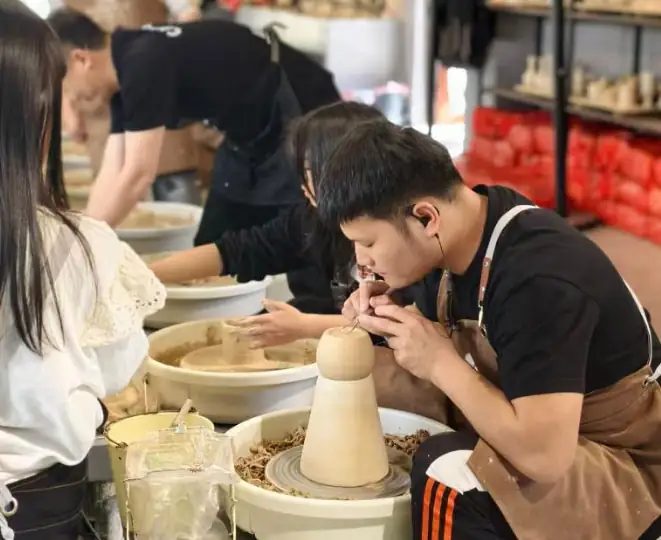
Sanbao Village in Jingdezhen now hosts more than 167 pottery experience studios, and on a public holiday the wait for a wheel-throwing session is longer than the wait at the kiln. At the same time, local ceramic companies have started shipping IP-themed blind-box ornaments and small "trendy ceramic derivatives" alongside the tableware they have always made.
Two facts, one conclusion: the most famous porcelain city in China is no longer organised around export tableware. For a buyer this is not trivia. It changes who you are actually buying from, what a factory will quote you, and where your product idea is likely to be copied next.
What actually changed in Jingdezhen
For thirty years the city's economy ran on container loads of bowls, plates and vases made for Western retailers. That business still exists, but the margin has gone, and the capacity has partly moved to Chaozhou, Dehua and Liling. What stayed in Jingdezhen is the part that cannot be moved: the craft skill, the glaze knowledge, and now the tourism that pays for both.
Three things followed:
- Studio-scale production became viable. A workshop with two kilns and six painters can now sell direct through live-streaming and short-term visitors, so it no longer needs a wholesaler to survive.
- The city became a design centre rather than a production centre. Young ceramists arrive to study, stay for a season, and end up designing for factories in other provinces.
- Small-format ceramic products appeared. Blind boxes, fridge magnets, keychains, miniature figures - items designed for a 30-80 RMB impulse purchase rather than a shipping carton.
Two supply chains, not one
The single most expensive mistake a buyer makes in China is assuming that any supplier who says "Jingdezhen ceramic" can deliver a wholesale order. There are two distinct supply chains in the same city, and they are not interchangeable.
The studio chain
One to fifteen people, a small electric kiln, hand-thrown or slip-cast bodies, glazes mixed in-house, output measured in dozens per week. Strengths: original design, unusual glazes, and a real willingness to make something that has never existed. Weaknesses: no consistent colour between batches, no formal QC, no export documentation, and no ability to hold a 3,000-piece delivery date.
The factory chain
80 to 800 staff, tunnel or shuttle kilns, moulds cut in-house, decal and hand-paint lines, a QC department and a shipping desk. Strengths: repeatability, a documented tolerance, and a price that works at volume. Weaknesses: minimum order quantities, a design language shaped by what already sells, and a QC system that treats every deviation as a defect - including the deviations a studio look depends on.
If your product needs to look handmade and ship in thousands, you are not choosing between the two. You are briefing the factory chain to reproduce a studio result, which is a specification problem rather than a sourcing problem. The same logic applies when you buy glazed ceramic lucky cats: the range has to be reproducible, so the "hand-finished" part has to be written down rather than left to the painter.
The DIY pottery trend is a product category, not just tourism
The 167 experience studios are the visible tip. Underneath them is a supply chain for people who paint ceramics rather than make them: cafés, kids' party venues, hen-party studios, school programmes and mall pop-ups. If you sell into that market, the specification is completely different from a finished gift.
- Bisque, not glazed. Unglazed fired blanks take paint and pencil; a glazed piece does not. Ask for "bisque only" or "white body, no glaze" explicitly - the default answer to "ceramic mug" is a glazed one.
- Bisque costs less. Skipping the glaze line and the decorative firing removes 30-40% of the processing cost, so a blank mug and a finished mug are not comparable quotes.
- Consistency of the surface matters more than the shape. A blank with a ripple or a dust nib will show through every brushstroke. Specify a smooth bisque and check it with a wet finger, not a photograph.
- Sell the firing, not the object. Most studio customers need to know the piece can survive a second firing at 1,000°C without crazing. That is a body-composition question, and it is worth asking in writing.
The related consumable is colour. Studios that run paint-your-own sessions buy underglaze colours, brushes and aprons in bulk, which is a different order profile from a gift shop buying finished stock - and a reason to look at our coloured pencil and art set range if you serve the same customer.
Blind boxes: the small-format opportunity with a compliance tail
The second trend in the news is the IP blind box. For a gift shop the appeal is obvious: low unit price, repeat purchase, collectible behaviour, and a counter display that costs almost nothing in floor space. Four practical points before you order:
- Blind box is a packaging format, not a product. The ceramic figure inside is ordinary; the sealed foil bag, the ratio card and the display box are what create the mechanic. Ask for the assortment ratio in writing, because "random" without a ratio is how a case of twelve arrives with six duplicates.
- Small ceramic figures break. Under 6 cm, the ears, tails and raised paws are the failure points. Ask for the drop-test result and the carton configuration, and expect a breakage allowance in the price.
- If the buyer is a child, toy rules apply. Small parts, sharp edges and coating safety move the product from "gift" to "toy" in most markets, and the test file has to exist before the container ships.
- Original IP is the whole value. A generic blind box sells once. If you commission the character, the design file, the exclusivity term and the mould ownership all have to be in the contract - see the OEM and custom page for how that is normally structured.
Why this is also why your quote went up
Tourism competes for the same kiln capacity as export production. In the weeks around a major ceramics fair or a holiday, a Jingdezhen factory can fill its schedule with small, high-margin studio orders and tourist-facing retail work, which makes a 5,000-piece order at 12 RMB look unattractive. Buyers who used to get a same-week quote now wait two weeks, and the price has a tourism premium baked into it.
Two responses work. The first is to place the order outside the peak booking window, which in Jingdezhen means avoiding the month before and after the autumn fair. The second is to stop treating Jingdezhen as the only answer: for a reproducible gift line, the same mould and the same decal can often be produced more cheaply and more punctually in Dehua or Chaozhou, with the design signed off in Jingdezhen.
Briefing a factory to produce a "studio look"
This is the part buyers underestimate. A factory QC inspector is trained to reject uneven glaze, visible throwing rings, iron spots and slightly irregular rims. Those are exactly the signals that make a piece read as handmade. If you want them, you have to reverse the default in writing.
- Send a physical master, not a photo. Colour and surface cannot be approved from a screen.
- Write an accept list and a reject list. "Reactive glaze variation of this type is accepted; crazing, chips and bare patches are rejected."
- Name the tolerance numerically where you can. Rim flatness within 1 mm, height within 3%, glaze thickness such that the body colour does not show through.
- Agree the second-quality rate. A reactive glaze can run 15-25% seconds. Price per good unit, not per unit fired, or the yield lands on you.
What this means for a gift shop range
The practical read for a buyer with limited shelf space: the studio trend rewards small quantities of characterful pieces and punishes deep stock of sameness. That fits a low-MOQ model rather than a container model - see what ships from a single carton, and if you are building a first assortment for a gift or souvenir shop, the gift shop sourcing page groups the ranges by retail use rather than by factory.
For reference, the glazed figures most shops start with are the medium waving lucky cat, the large coin-bank cat and the small shelf-size cat - three price points, one display story. On the vessel side, the glazed ceramic vase and ceramic mug show what the same factory body looks like when the decoration is the product.
The one-line version
Jingdezhen has become a design and craft city that also manufactures. Buy there for the finish and the idea, buy elsewhere for the volume, and put the finish into a written specification before you pay a deposit.