
A Chinese Ceramicist Won in Slovenia. What It Signals for Sourcing.
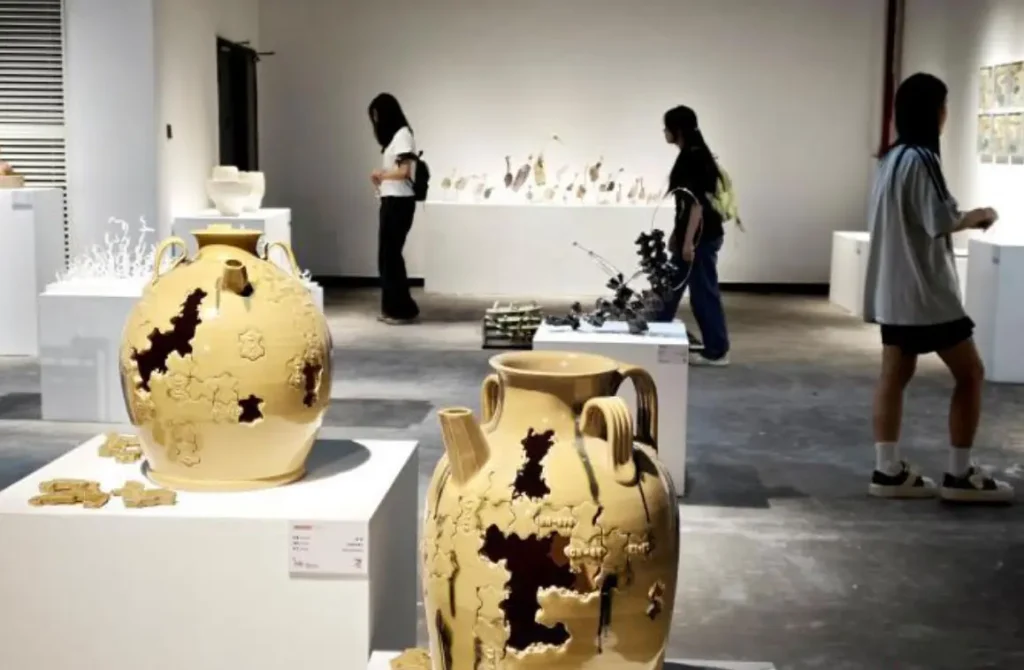
At the 6th UNICUM World Triennial of Ceramics in Slovenia this May, Chinese artist Duan Yijian was shortlisted and took the Ilirika Acquisition Award, with the work entering a permanent institutional collection. The exhibition drew ceramicists from several dozen countries, and the citation that travelled with the result was specific: work that moves past antique imitation, integrates ink-painting sensibilities into porcelain, and reads to a European jury as contemporary rather than derivative.
A single award is not a market event. But the sentence behind it - that Chinese ceramic work is now assessed on design rather than on craftsmanship alone - describes something buyers have been quietly benefiting from for about five years. The factories got better at design. Most sourcing briefs have not caught up.
The shift, in commercial terms
Ten years ago a Chinese ceramic factory competed on price, and the buyer's job was to bring the design. Today a mid-sized factory in Dehua, Chaozhou or Jingdezhen is likely to have an in-house design team, a glaze laboratory, and a colour library of several hundred reactive finishes. Three practical consequences:
- Finish development is faster and cheaper. A new reactive glaze used to mean a three-month external trial. In-house labs now run it in two to three weeks for a few hundred dollars, which is within reach of a buyer testing a single SKU.
- Small-batch colour work is normal. Matte, satin, crystalline, volcanic, metallic and speckled finishes are all catalogued rather than invented per order.
- Original design is on the table at mid volume. A factory that used to quote only on stock shapes will now cut a mould for 500 pieces if the design is likely to be reordered.
That is the same capability that produced the award. The gap is no longer "can they make it" but "can you specify it".
What a factory can genuinely do now
Being concrete helps, because "we can do any finish" is the most common answer in the industry and it is not true. What is realistic in 2026:
- Reactive and variegated glazes on a defined body, with a 15-25% second-quality rate. Reproducible within a range, not a fixed colour.
- Matte exterior with a gloss interior, on the same piece, if the body allows two glaze applications and the firing curve is adjusted.
- Mixed media: ceramic with wood, brass, rope or resin. This is where Chinese workshops are strongest, because the components are made in the same province.
- Fine relief and carved surfaces from a CNC-cut or hand-finished mould, at a tooling cost of 300-1,500 dollars depending on complexity.
- Hand-applied finishes - wiped glaze, sanded edges, exposed clay - which are labour, and therefore only economic at low volume or high price.
What is not realistic: a crystalline glaze with zero variation at 5,000 pieces; a specific Pantone match in a reactive glaze; or a hand-thrown look on a slip-cast body without a written tolerance that permits the "flaws" that create it.
How to brief an artistic finish so a factory can price it
Most briefs fail on adjectives. "Warm, handmade, organic" cannot be quoted. Four things can:
- A physical reference. Send the actual piece or a fired tile, not a JPEG. Colour on a screen is a different colour.
- A named process or its closest catalogue equivalent. "Reactive copper matte, similar to your reference R-14, variation acceptable" gives the lab something to start from.
- An accept list and a reject list. Reactive variation and iron speckling accepted; crazing, pinholes, bare patches and colour fade rejected. Without this, factory QC rejects the variation you wanted and accepts the pinholes you did not.
- A tolerance with a number. Height ±3%, rim flatness 1 mm, glaze coverage 100% with no body show-through, ΔE within 2 against the master under D65.
This is the same discipline that makes a glazed figurine range reproducible across sizes: the paint has to match between a 6 cm cat and a 32 cm cat, which is a written standard rather than an intention.
The trap: artistic is not the same as production-ready
A finish that photographs beautifully can be economically impossible, and the maths is brutal once you run it.
- Price per good unit, not per unit fired. A 25% second-quality rate on a 6-dollar piece means the good units cost 8 dollars before decoration labour. Buyers who compare quotes per fired unit are comparing the wrong number.
- Kiln capacity is the real constraint. A slow, low-temperature cycle for a speciality glaze can halve throughput without changing the labour cost.
- Repair is not possible. Unlike metal or wood, a fired glaze defect cannot be fixed. The piece is scrap, and the scrap is in your price.
- Seasonality compounds it. A finish that works in March fails in a July heatwave if the glaze room is not climate-controlled. Ask what the summer yield looks like.
The right question is not "can you make this" but "what is the yield on this finish, at this volume, in August". A supplier who answers with a number is a supplier worth negotiating with.
Design protection when you co-develop
If you commission an original shape or decoration, three things protect it, and only one of them is a lawyer's job:
- Contract terms. Mould ownership, exclusivity period, and a written prohibition on selling the design to third parties. In China, a signed contract plus a design drawing dated and stamped is the practical basis for enforcement.
- Registered design. EU and UK unregistered design rights give short-term protection automatically; a registered design or a US design patent is stronger and cheap relative to a mould. File before the first shipment, because public disclosure starts the clock.
- Commercial defence. Move fast, keep the next design in the pipeline, and never let one design carry the range. A supplier who knows you reorder every season has an incentive the contract cannot create.
The OEM and custom page sets out how tooling cost, mould ownership and exclusivity are normally structured for a first order.
A realistic path for a mid-size buyer
The award is not a reason to commission art. It is a reason to stop assuming that a distinctive finish requires a European studio. A workable sequence for a gift shop or small chain:
- One hero piece. A single shape with a finish nobody else on your shelf has, at 300-500 units.
- A six-month cadence. Test, sell, reorder against the master sample, then add a second shape - not a full collection in one go.
- Keep the finish, change the form. A proven glaze travels across a mug, a vase and a figurine far more cheaply than a new glaze does.
- Test the finish on the tier that carries it. A reactive glaze reads as premium on a 35-dollar vase and as a defect on a 9-dollar mug.
Our tall glazed vase and tableware set are the two shapes where a finish change is most visible to a shopper, and the gift shop sourcing page groups the ranges by the shelf they belong on rather than by factory line. If you are commissioning rather than buying stock, start with the low-MOQ guide so the first order is a test rather than a bet.
The short version
Chinese ceramics moved from "can you make this cheaply" to "can you specify this precisely". The award confirms the capability; the brief is still your job. Write the accept list, agree the yield, and price per good unit - that is what turns an artistic finish into a product that ships.